
Craftsman Roller Replacement: The California Owner’s Guide
Craftsman roller replacement in California typically runs $110-$220 installed, and we stock the common sizes on every truck for same-visit repair. Most Craftsman doors use 2-inch or 3-inch steel rollers with a 7/16-inch stem, though the newer belt-drive compatible doors sometimes ship with nylon variants that wear faster in our heat. You’ll usually notice the failure first as a rhythmic grinding or a door that shudders past certain points in the track, especially on the morning run when the metal’s cold and the bearings are at their stiffest.
Which Craftsman Models This Applies To
Craftsman garage door openers and door systems have been sold through Sears, Lowe’s, and Ace Hardware for decades, which means the same opener brand got paired with several different door manufacturers over the years. The roller spec depends on the door itself, not the opener, so a Craftsman 1/2 HP chain-drive from 2008 might sit on a Clopay, Amarr, or Wayne Dalton door, each with slightly different roller requirements.
We see three main roller types on Craftsman-labeled systems in California:
- Standard 2-inch steel rollers - Most common on pre-2015 doors, 10-ball bearing or plain sleeve. These last 8-12 years in normal conditions, but Inland Empire dust and Central Valley heat cut that closer to 6-9.
- 3-inch heavy-duty steel rollers - Found on wider 16-foot Craftsman doors and any with rigid insulation. The larger diameter reduces bearing load but needs a matching track radius.
- Nylon-coated quiet rollers - Standard on newer Craftsman “whisper drive” compatible doors. Smoother but softer; the nylon cracks after 4-7 years in direct sun, which is why we see so many failed sets in Bakersfield and Fresno garages.
The part number you need is usually stamped on the roller stem or the door’s edge sticker. If that’s worn off, we measure stem diameter (7/16-inch is standard, 1/2-inch on some commercial-grade units), roller diameter, and whether the stem is plain or grooved for a retaining clip. We carry OEM-equivalent rollers and premium aftermarket options from the same factories that supply LiftMaster, Chamberlain, and Genie systems. We’re an independent service company with no affiliation to Craftsman or Sears, so we match the part to your door, not your brand loyalty.
Signs Your Craftsman Roller Replacement Is Failing
- Grinding or squealing that lubrication won’t fix. The bearings inside the roller have dried out or the races have pitted. A shot of white lithium grease quiets it for a week, then the noise returns louder. In California’s dry climate, bearing grease evaporates faster than in humid regions, so this failure mode shows up earlier than the national averages suggest.
- The door shudders or “hops” at the same height every cycle. One roller has a flat spot or seized bearing, causing it to skid rather than roll. The shudder point usually matches a track joint or the high-stress transition from vertical to horizontal.
- Visible roller wobble or the roller popping out of the track. The stem has bent or the roller body has worn eccentric. This is the point where the door becomes unpredictable - it might finish the cycle, or it might jump the track entirely.
- Rust-colored dust on the track or floor beneath the door. Steel rollers shedding their bearing cages. By the time you see the dust, the roller is already grinding metal-on-metal and scoring the track.
- The door feels heavier to lift manually. Failed rollers add rolling resistance that the opener compensates for until the motor or logic board burns out. We check this on every service call because it’s the failure that hides inside another failure.
Replacement Cost & What’s Included
| Service | Price Range |
|---|---|
| Craftsman roller replacement (per door, 10-12 rollers) | $110-$220 |
| Single roller replacement (emergency, off-track recovery) | $130-$180 |
| Upgraded sealed-bearing rollers (premium option) | $160-$260 |
The $110-$220 range covers standard steel rollers, labor to remove and replace, track inspection, and door balance verification. What pushes it higher: nylon-to-steel upgrades, bent stems seized in the hinge brackets, or doors that have been running with failed rollers long enough to damage the track itself. We price by the job, not by the roller count, because the labor is in the access, not the threading. Every roller replacement includes a full system check - spring tension, cable wear, opener force settings - because if the door isn’t moving right, something isn’t set right, and that’s always a fixable problem. Warranty is 2 years on parts and labor for standard rollers, 5 years on sealed-bearing upgrades.
DIY or Call Us?
Here’s what’s reasonable to check yourself and where it gets complicated.
Safe to inspect: With the door closed and the opener disconnected (pull the red release handle), visually check each roller for wobble, rust, or cracks. Spin them by hand - they should turn freely and quietly. If one feels gritty or locks up, mark it with tape. This tells you what you’re dealing with, and we’re happy to talk through what we find when you call.
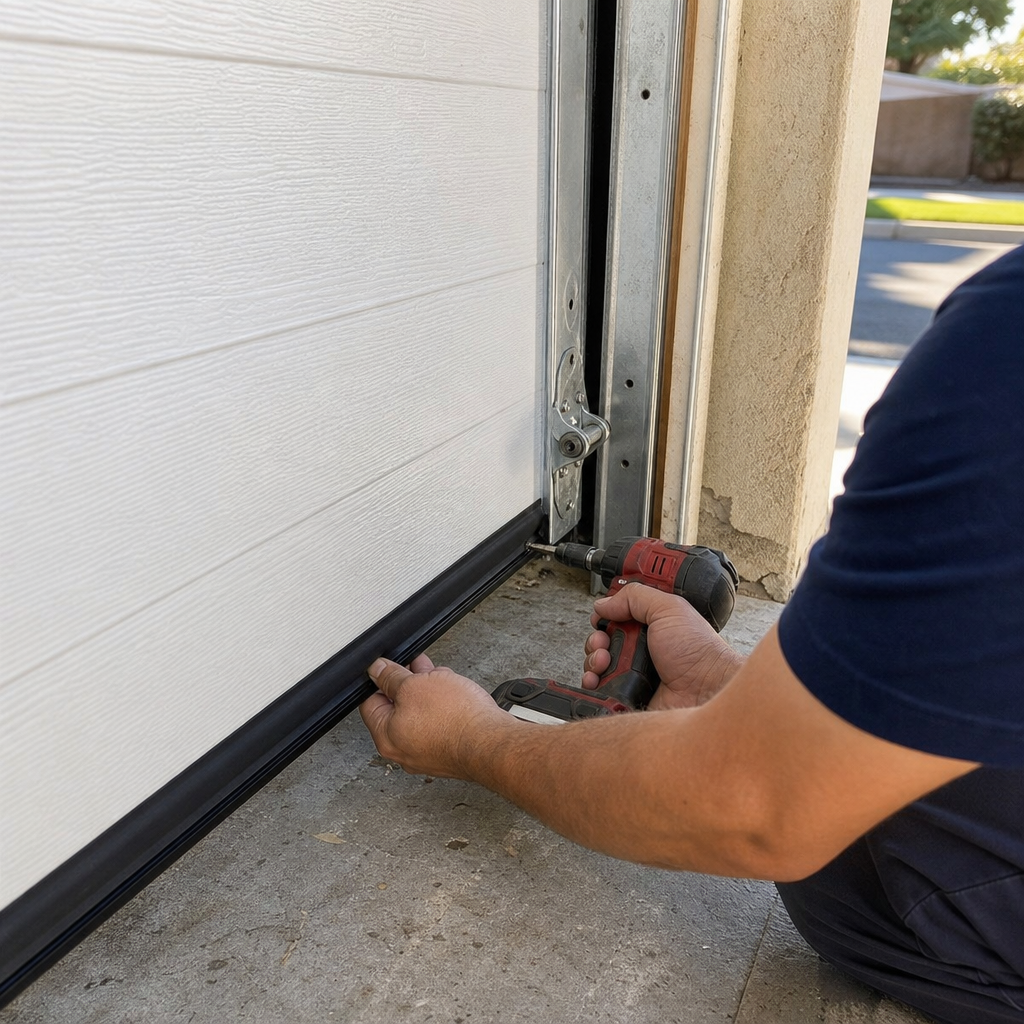
Where DIY goes wrong: Replacing rollers requires partially disassembling the door hinges while the door is in a controlled position. The bottom fixtures are under spring tension, and the door can shift or drop if the hinge bolts are removed in the wrong sequence. We’ve recovered doors from homeowners who got one roller out and couldn’t get the new one seated, leaving the door jammed half-open. For roller replacement specifically, the risk is moderate - not spring-level dangerous, but a 150-pound door moving unexpectedly can crush fingers or wrench a shoulder. If you’re not comfortable with the weight and the hinge geometry, we’re equipped to do the full set in under an hour.
Call (855) 574-1819 and we’ll confirm your roller spec over the phone, or schedule a same-day visit if the door’s stuck or off-track.
FAQs
Standard steel rollers last 6-9 years in California’s dry, hot climate, compared to 10-12 years in milder regions. Nylon rollers degrade faster in direct sun, often 4-7 years. Coastal salt air accelerates bearing corrosion, so rollers in Ventura or Orange County garages sometimes fail earlier than inland units. Call (855) 574-1819 if you’re unsure of your rollers’ age - we can date them by the wear pattern.
No. Once the bearing is shot or the roller body is cracked, replacement is the only durable fix. We’ve seen homeowners try to repack bearings or shim wobbly rollers, but the stem and race are already damaged. The right fix is a new roller matched to your door’s weight and track radius, not a temporary patch. We stock the common sizes for same-visit replacement.
A full set replacement on a standard 16×7 door takes 45-60 minutes, including removal, installation, and post-work balance check. Single-roller emergency calls run 20-30 minutes if the door is still on-track. We carry the parts, so there’s no ordering delay. Same-day appointments are available throughout California.
Yes. We stock 2-inch and 3-inch steel rollers, nylon-coated variants, and sealed-bearing upgrades on every service truck. Because we also service LiftMaster, Chamberlain, Genie, Clopay, Amarr, Wayne Dalton, and Raynor systems, our parts inventory covers the cross-compatible components most Craftsman doors actually use. If you have an unusual stem size or a discontinued Craftsman door series, we’ll source it overnight - but that’s rare.
Written by Dale Okonkwo, Owner & Lead Technician, Mainspring Garage Door Co. of California at Mainspring Garage Door Co. of California, serving California and nearby areas.